Categoría: Measuring Sentience

  • Andrés Gómez-Emilsson on Logarithmic Scales of Pleasure and Pain: Rating, Ranking, and Comparing Peak Experiences Suggest the Existence of Long Tails for Bliss and Suffering

    I briefly explain that while some distributions (e.g. the size of the leaves of a tree) follow a Gaussian bell-shaped pattern, many others (e.g. avalanches, size of asteroids, etc.) follow a long-tail distribution. Long-tail distributions have the general property that a large fraction of the volume is accounted for by a tiny percent of instances (e.g. 80% of the snow that falls from the mountain will be the result of the top 20% largest avalanches).

    I then explain that based on previous research we have conducted at the Qualia Research Institute we have arrived at the tentative conclusion that the intensity of pleasure and pain follow a long-tail distribution. Why?

    First, neural activity on patches of neural tissue follow log-normal distributions (an instance of a long-tail distribution).

    Second, the extremes of pleasure and pain are so intense that they cannot conceivably be just the extremes of a normal distribution. This includes, on the positive end: Jhana meditation, 5-MeO-DMT peak experiences, and temporal lobe epilepsy (Dostoevsky famously saying he’d trade 10 years of his life for just a few moments of his good epileptic experiences). On the negative end, things like kidney stones, cluster headaches, fibromyalgia, and migraines top the charts of most intense pain.

    And third, all of the quantitative analysis we conducted on a survey about people’s best and worst experiences showed that the ratings, comparisons, and rankings of such experiences was far more consistent with a long-tail distribution than a normal distribution.

    I then conclude by saying that this is an *important*, *tractable*, and *neglected* cause.

    1) Important because we may be able to reduce the world’s suffering by a significant amount if we just focus on preventing the most intense forms of suffering.

    2) Tractable because there are already many possible effective treatments to these disorders (such as LSD microdosing for cluster headaches, and FSM for kidney stones).

    3) And neglected because most people have no clue that pain and pleasure go this high. Most utilitarian calculus so far seems to assume a normal distribution for suffering, which is very far from the empirical truth. Bentham would recoil at the lack of an exponent term when additively normalizing pain scales.

    I conclude by adding that in Effective Altruism there might be an implicit «youth» bias involved in the lack of knowledge of this phenomenon – due to the age of the people in the movement, most EA activists will not themselves have had intensely painful experiences. Thus, why it is so crucial to raise awareness about this topic in the community (it does not show up on its own). Simply put: because the logarithmic nature of pleasure and pain is *news* to most people in EA.
    Video, Article, Presentation given at EA New York

  • The systematic approach to suffering by Robert Daoust

    “The study of pleasure and pain belongs to the province of the political philosopher; for he is the architect of the end, with a view to which we call one thing bad and another good without qualification. ” – Aristotle, Nicomachean Ethics

    The systematic approach to suffering will present a collection of lists, a series of enumerations as exhaustive as possible concerning suffering, causes of suffering, people and organizations who cause suffering, factors of difficulty in work against excessive suffering, ideas of strategy, solutions, people and organizations who contribute to solve excessive suffering, documents interesting the systematic approach to suffering, and many other lists.

    All those inventories, mostly without precedent, call for a new type of gathering and classification work. And the interrelationships among all those elements will also call for new specialties. Moreover, it will be necessary to develop standardized procedures for measuring individual or collective suffering. Those measurements will be used to guide the work of prevention, reduction, suppression, eradication.

    Such a wider and more precise mapping of the field will better inform us on what is occurring and where we should go, will better prepare us to react to the evolution of the global problematique (for instance, it would make it possible to detect and control the harmful consequences of certain solutions, or to use advisedly new shrewd tactics). It will make it easier for us to find our way through the abundance, the vastitude and the complexity of the subject.

    The systematic approach to suffering proposes a general plan of solution to the whole problem of excessive suffering; it proposes which steps would lead to a global victory; it proposes a framework apt to accomodate all collaborations and to organize usefully their theoretical or practical contributions; it offers «an operational environment supporting the mutual reinforcement of the approaches and the projects of solution, too often isolated and vulnerable at present.

    Read more

  • Farmed Salmon May Be Depressed

    Researchers find that growth-stunted farmed salmon show chronic serotonergic activity and do not respond to acute stress — a state that could be interpreted as depression.

    In the vertebrate brain, serotonin mediated signaling is vital for several key physiological functions such as the body’s energy regulation, neural plasticity, behavioral and emotional control, and responses to stress. However, prolonged serotonin activation is associated with chronic stress and stress-induced pathologies in mammals. Such states include depression-like behaviors. This paper represents the first physiological data, showing that growth-stunted commercially farmed salmon have elevated serotonergic activity; what’s more, this is determined as the main characteristic of the growth-stunted phenotype. Compared to healthy fishes, these salmon are suggested to experience chronic stress. In fact, the researchers show that the fishes’ brains are not responsive to additional acute stress, representing a classic example of when regulatory mechanisms are unable to react to further challenges, indicating a depressive state.

    Read more

  • The evilness of suffering

    “I believe that most of us tend to underrate the evilness of suffering. The reason is that it is difficult for us, when not actually suffering, to recollect what suffering really is. We employ numerous psychological mechanisms to conceal from our consciousness the true nature or meaning of suffering, to falsify and deny it. We do this without renouncing the word, however. The word comes to designate, in our minds, only a faint copy or superficial image of the real thing; but having forgotten what the original is, we mistake it in the copy. We ascribe to “suffering” a certain gravity of evil; but it is slight compared to what we would ascribe to suffering itself, if we could only recall its true meaning.

    […]

    The falsification of suffering is everywhere — in movies, in poetry, in novels, on the nightly news. Accounts of disaster routinely veer from a discussion of the agony and plight of the victims (which quickly becomes tiresome) to the description of some moving act of kindness or bravery. Often it is these descriptions that affect us the most and that provoke the greatest outburst of emotion. These are the images we often take away and that become our image of “suffering.” Suffering comes to be closely associated with stirring images of hope in adversity, acts of moral heroism and touching kindness, gestures of human dignity, sentiments of noble sympathy and tremulous concern, the comfort and consolation of tears. It turns into something beautiful. It becomes poetry. People begin to refer to “sublime suffering.” Suffering, in other words, becomes just exactly what it is not.”

    – “Suffering and Moral Responsiblity” by Jamie Mayerfeld.

    Source: Qualia Computing

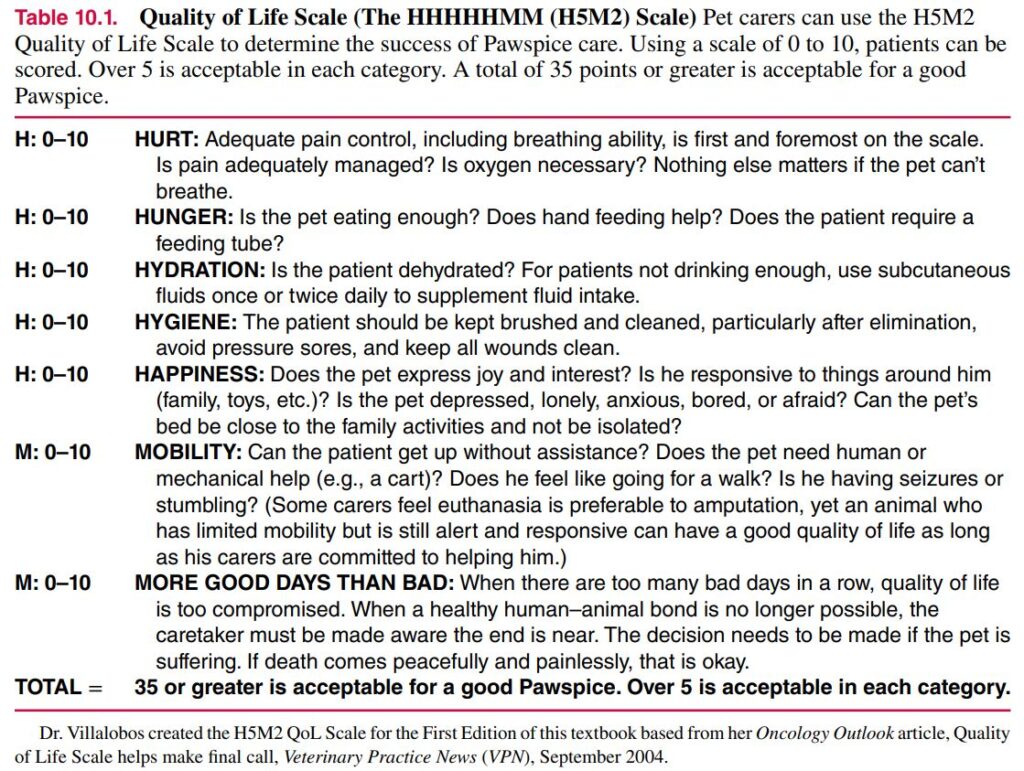
  • The HHHHHMM (H5M2) Quality of Life Scale

    «The HHHHHMM (H5M2) Quality of Life Scale provides guidelines for the assessment of a pet so that pet owners can maintain a rewarding relationship that nurtures the human–animal bond, while being confident that the pet is well enough to justify prolonging life. This Quality of Life Scale will relieve guilt feelings and engender the support of the veterinary team to actively help in the care and decision making for Pawspice patients. I feel that it is ethical to prolong a life worth living. On the other hand, I feel that it is not ethical to prolong death for our patients.»

  • The “Eternal-Playlist” thought experiment

    Privileged beings (students) of the privileged species (human) at privileged time (XXI c.) and privileged space (Germany) ranked only 30% of the recent experiences as «worth living».

    The “Eternal-Playlist” thought experiment, by Thomas Metzinger:

    «At Johannes Gutenberg University in Mainz, we began a first series of small pilot studies with a group of advanced philosophy students. We chose a signal-contingent, externally cued form of experience sampling. One tech-savvy student programmed an SMS server in such a way that, for seven days, it sent ten signals a day at random points in time to the participants, whose cell phones would then briefly vibrate. The participants’ task was to decide whether the last moment before the conscious experience of the vibration was a moment they would take with them into life after death. For many, the result was surprising: the number of positive conscious moments per week varied between 0 and 36, with an average of 11.8 or almost 31 per cent of the phenomenological samples, while at 69 per cent a little more than two thirds of the moments were spontaneously ranked as not worth reliving. If you are cued externally, it seems, less than a third of such experiential samples would have a chance of entering your very own “eternal playlist”.
    […]
    in a second study we dropped the afterlife assumption and the “eternity condition”, replacing them with the following question: “Would you like to relive the very last conscious moment in this life?” Interestingly, under this condition only a little over 28 per cent of life moments were ranked as positive, while just below 72 per cent were considered not worth reliving

    Source:
    https://www.blogs.uni-mainz.de/fb05philosophieengl/files/2013/07/Metzinger_Suffering_2017.pdf

  • The Sad Truth About Happiness Scales: Empirical Results

    «We replicate nine key results from the happiness literature: the Easterlin Paradox, the ‘U-shaped’ relation between happiness and age, the happiness trade-off between inflation and unemployment, cross-country comparisons of happiness, the impact of the Moving to Opportunity program on happiness, the impact of marriage and children on happiness, the ‘paradox’ of declining female happiness, and the effect of disability on happiness. We show that none of the findings can be obtained relying only on nonparametric identification. The findings in the literature are highly dependent on one’s beliefs about the underlying distribution of happiness in society, or the social welfare function one chooses to adopt. Furthermore, any conclusions reached from these parametric approaches rely on the assumption that all individuals report their happiness in the same way. When the data permit, we test for equal reporting functions, conditional on the existence of a common cardinalization from the normal family. We reject this assumption in all cases in which we test it.»

    Source: https://www.nber.org/papers/w24853

  • Are suffering and enjoyment measurable?

    In Simon Knutsson‘s words:

    That happiness and suffering are measurable, in principle, to the extent that is required to talk about the net balance among several individuals is highly controversial and widely rejected. That is, it is controversial that they are (in principle) measurable to the required degree in an objective, non-arbitrary, scientific way that does not involve value judgements on the part of the person doing the measurement. One could say «I assign number –10 to Ann’s suffering and +5 to Ben’s happiness, and then I add them together. These numbers are intertwined with my values, and others might assign different numbers depending on their values.» Although that might be the best we can do, it does not count as measurement in the objective sense that we are concerned with […].

    Economist Yew-Kwang Ng says that the following statement is representative of the typical economics textbook view: «Today, no one really believes that we can actually measure utils.» He continues that the probably most widely used textbook says that «economists today generally reject the notion of a cardinal, measurable, utility.» For the kinds of claims discussed above, we would need utilities to be measurable on a strong kind of interpersonal cardinal scale (an interpersonally additive ratio scale), which is widely rejected by economists.
    Ng adds that this skepticism about measurability is also «very common» among «sociologists and psychologists who study happiness.»

    Some history is interesting here. The early utilitarians of the 19th century, such as John Stuart Mill and Henry Sidgwick, did not seem worried by interpersonal comparisons of utility. But as Bergström points out, «in the 20th century, things have changed a great deal. Now the dominant view — at least among economists — seems to be that interpersonal comparisons of utility are impossible or necessarily subjective and unscientific.»

    Of course, there is not complete consensus on the matter; some believe that happiness and suffering (or utility) can be measured to the extent required to talk about the net balance or amounts among several individuals. Philosophers generally seem to be somewhat more optimistic than economists.

    Source: https://foundational-research.org/measuring-happiness-and-suffering/

  • What does «more suffering than happiness» means?

    In Magnus Vinding‘s [1] words [2]:

    I think there is a problem with underspecified [in expressions] like “more suffering than happiness” […] For example, talking about “whether suffering or enjoyment is more common” (in this piece [3]) sounds rather descriptive, whereas saying that, or whether, “suffering predominates” (ibid.) will often have evaluative and/or moral connotations. The same is true of a term like welfare: it often has an evaluative/axiological meaning as opposed to a purely descriptive one (see e.g. sec. 1.1.1 here: https://tspace.library.utoronto.ca/bitstream/1807/92027/3/Mathison_Eric_201811_PhD_thesis.pdf [4]).

    Indeed, the question as to “whether suffering predominates” can mean at least three very different things […]

    For one, it may refer to a purely descriptive statement: there is a greater quantity of happiness than suffering, by some given measure. (And this, in turn, implies further questions concerning how one indeed measures happiness and suffering, in particular how one measures them against each other, and whether they are even commensurable, not just evaluatively but also in purely descriptive terms, cf. https://foundational-research.org/measuring-happiness-and-suffering/ [5] and https://animalstudiesrepository.org/animsent/vol1/iss7/18/ [6])

    Second, it may mean something along evaluative lines such as “there is more positive value than negative value” in the existing happiness and suffering respectively. And this is a very different claim in that one can claim there is far more happiness than suffering in the world, by some given measure, yet still maintain that the disvalue of the suffering is far greater than the value of the happiness. Indeed, quite a number of philosophers and traditions in the East (cf. http://blogs.dickinson.edu/buddhistethics/files/2015/12/Breyer-Axiology-final.pdf [7]) and the West (including Epicurus and Schopenhauer) have defended views according to which the disvalue of suffering dominates that of happiness entirely; for recent defenses of such views, see Gloor: https://foundational-research.org/tranquilism/ [8] and Wolf: https://jwcwolf.public.iastate.edu/Papers/JUPE.HTM [9].

    Third, one can think there is far more happiness than suffering in the world, even in evaluative terms, yet still think the suffering carries much greater moral/deontic significance; asymmetries of this kind have in fact been defended by quite a few prominent philosophers, including W. D Ross, cf. sec. 2.5 here: https://tspace.library.utoronto.ca/bitstream/1807/92027/3/Mathison_Eric_201811_PhD_thesis.pdf [10]

    Beyond that, there are also issues concerning intra and inter-personal trade-offs: even if most lives in nature contain far more happiness than suffering (by some assumed measure), this would not mean that the happiness of some beings can ever outweigh the suffering of others, either in evaluative terms or deontic terms. Many ethicists accept intra-personal trade-offs while rejecting inter-personal ones (for instance Richard Ryder and Stevan Harnad, and to some extent Jamie Mayerfeld).

    The perhaps most important question to ponder deeply, in my view, is whether we think any amount of happiness can morally outweigh the very worst of suffering. I have argued in the negative: https://magnusvinding.com/2018/09/03/the-principle-of-sympathy-for-intense-suffering/ [11] and so have philosophers Jamie Mayerfeld, Joseph Mendola, Ingemar Hedenius, and Ragnar Ohlsson, among others.

    Just thought this was worth pointing out. Notions of “net negative” and “net positive” lives — as pertaining both to single individuals and (especially) to groups — require serious unpacking in terms of their meaning and assumed evaluative and moral implications.


    Links and references

    [1] https://magnusvinding.com/

    [2] https://www.facebook.com/groups/suffering.in.nature/permalink/2727855270577587/

    [3] http://www.zachgroff.com/2019/06/how-much-do-wild-animals-suffer.html

    [4] https://tspace.library.utoronto.ca/bitstream/1807/92027/3/Mathison_Eric_201811_PhD_thesis.pdf

    [5] https://foundational-research.org/measuring-happiness-and-suffering/

    [6] https://animalstudiesrepository.org/animsent/vol1/iss7/18/

    [7] http://blogs.dickinson.edu/buddhistethics/files/2015/12/Breyer-Axiology-final.pdf

    [8] https://foundational-research.org/tranquilism/

    [9] https://jwcwolf.public.iastate.edu/Papers/JUPE.HTM

    [10] https://tspace.library.utoronto.ca/bitstream/1807/92027/3/Mathison_Eric_201811_PhD_thesis.pdf

    [11] https://magnusvinding.com/2018/09/03/the-principle-of-sympathy-for-intense-suffering/

  • The case of Dax Cowart

    «I was burned so severely and in so much pain that I did not want to live even in the early moments following the explosion. A man who heard my shouts for help came running down the road, I asked him for a gun. He said, ‘Why?’ I said, ‘Can’t you see I am a dead man? I am going to die anyway. I need to put myself out of this misery.’ In a very kind and compassionate caring way, he said, ‘I can’t do that.’»

    Read more

    «We might give more weight to the judgments of those who have already been tortured, since their evaluations of the experiences are presumably more accurate. Unfortunately, here too people may forget the severity of their past suffering. This empathy gap often happens to me when I think back on my own past experiences of intense suffering, unable to conjure up feelings of how awful I felt at the time.» (Brian Tomasik)

    «Sometimes people who suffer enormously do look back and judge that their suffering wasn’t worth it. Consider the case of Dax Cowart, who suffered so badly that he wished he had been killed, even in retrospect.»

    Read more