Categoría: Sentience in Humans

  • Are suffering and enjoyment measurable?

    In Simon Knutsson‘s words:

    That happiness and suffering are measurable, in principle, to the extent that is required to talk about the net balance among several individuals is highly controversial and widely rejected. That is, it is controversial that they are (in principle) measurable to the required degree in an objective, non-arbitrary, scientific way that does not involve value judgements on the part of the person doing the measurement. One could say «I assign number –10 to Ann’s suffering and +5 to Ben’s happiness, and then I add them together. These numbers are intertwined with my values, and others might assign different numbers depending on their values.» Although that might be the best we can do, it does not count as measurement in the objective sense that we are concerned with […].

    Economist Yew-Kwang Ng says that the following statement is representative of the typical economics textbook view: «Today, no one really believes that we can actually measure utils.» He continues that the probably most widely used textbook says that «economists today generally reject the notion of a cardinal, measurable, utility.» For the kinds of claims discussed above, we would need utilities to be measurable on a strong kind of interpersonal cardinal scale (an interpersonally additive ratio scale), which is widely rejected by economists.
    Ng adds that this skepticism about measurability is also «very common» among «sociologists and psychologists who study happiness.»

    Some history is interesting here. The early utilitarians of the 19th century, such as John Stuart Mill and Henry Sidgwick, did not seem worried by interpersonal comparisons of utility. But as Bergström points out, «in the 20th century, things have changed a great deal. Now the dominant view — at least among economists — seems to be that interpersonal comparisons of utility are impossible or necessarily subjective and unscientific.»

    Of course, there is not complete consensus on the matter; some believe that happiness and suffering (or utility) can be measured to the extent required to talk about the net balance or amounts among several individuals. Philosophers generally seem to be somewhat more optimistic than economists.

    Source: https://foundational-research.org/measuring-happiness-and-suffering/
  • A compass that is perpetually «stuck on South»

    «If someone offered you a pill that would make you permanently happy, you would be well advised to run fast and run far. Emotion is a compass that tells us what to do, and a compass that is perpetually stuck on north is worthless.» —Professor Daniel Gilbert. Department of Psychology, Harvard University

    «Many millions of people in the contemporary world have a compass that is perpetually «stuck on South». They are always unhappy and discontented. They endure chronic pain and/or depression. Some victims of severe anhedonia can’t even imagine what it’s like to be happy. A minor blessing is that not all of their days are quite as terrible as others. So in one sense, their emotional compass can point North as well as South: a motivational system of sorts still functions. But the whole of their lives is spent in an Antarctic wasteland of misery and despair.

    At the other extreme, a small minority of people are blessed with a compass that seems perpetually «stuck on North». In pathological cases, they may be manic. But sometimes they are in varying degrees just «hyperthymic» i.e. the hedonic set-point around which their lives oscillate is unusually high compared to the Darwinian norm. Hyperthymic well-being is chronic; yet it’s not uniform. Thus some days of hyperthymic life are even more wonderful than others; pursuing their favourite activities makes hyperthymics even happier than otherwise. So again, the hyperthymic emotional compass is bidirectional: its scale is different, but it works. The relevant contrast here lies in the way hyperthymics are animated by information-signalling gradients of well-being, whereas dysthymics, depressives and victims of chronic pain spend their lives struggling to minimise ill-being. Either way, affective gradients rule.» —David Pearce

    Source: https://www.gradients.com/

  • Ideology of Reproduction versus Non-Suffering and conservatism vs progressivism

    «While every sensitive being fundamentally wishes to avoid suffering and experience happiness, curiously, human societies have almost never made non-suffering and happiness their founding values. Why? The ideology of reproduction has existed for 100,000 years, while the belief that the spirit survives the death of the body appears. We must reproduce so that a progeny can take care of our spirit after our death. The supreme value is reproduction, and therefore life. The strength of this discourse is such that the ideology of reproduction, which has forged most of our laws, has finally imposed itself through unconscious internalization, even today. To come out of it, to deconstruct this ideology is a condition for the flourishing of the values of non-suffering and happiness that appeared much later, only 2500 years ago, in India and Greece.»

    From the Jean-Christophe Lurenbaum’s book: «Is “Being Born” in the Best Interest of the Child? – Ideology of Reproduction versus Non-Suffering»

    «A key to understanding what is behind conservatism and progressivism is that the former is pro-life or for «reproduction» in the broad sense, whilst the latter is for suffering-alleviation» — Robert Daoust


  • One woman is entirely insensitive to physical pain

    One woman is entirely insensitive to physical pain and has no palpable negative emotions.

    Joanne Cameron experiences suffering mostly as “an abstract thing.”

    https://www.newyorker.com/magazine/2020/01/13/a-world-without-pain

  • The case of Dax Cowart

    «I was burned so severely and in so much pain that I did not want to live even in the early moments following the explosion. A man who heard my shouts for help came running down the road, I asked him for a gun. He said, ‘Why?’ I said, ‘Can’t you see I am a dead man? I am going to die anyway. I need to put myself out of this misery.’ In a very kind and compassionate caring way, he said, ‘I can’t do that.’»

    Read more

    «We might give more weight to the judgments of those who have already been tortured, since their evaluations of the experiences are presumably more accurate. Unfortunately, here too people may forget the severity of their past suffering. This empathy gap often happens to me when I think back on my own past experiences of intense suffering, unable to conjure up feelings of how awful I felt at the time.» (Brian Tomasik)

    «Sometimes people who suffer enormously do look back and judge that their suffering wasn’t worth it. Consider the case of Dax Cowart, who suffered so badly that he wished he had been killed, even in retrospect.»

    Read more

  • On Kidney stones, by Andres Gomez Emilsson

    I’ve never had a kidney stone. Thank God. According to Quora responses to the question «How painful are kidney stones?» they are about as painful as it gets. They’re the most painful thing a person can experience naturally, leaving aside torture and violent body-dismembering events. Many say they often get to be «10/10 pain». That’s clearly an ethical catastrophe given that 10% of people experience them at least once during their lifetime.

    Someone described the experience of having a kidney stone as «indistinguishable from being stabbed with a white-hot-glowing knife that’s twisted into your insides non-stop for hours».

    I wonder whether from a compassionate (utilitarian/consequentialist) point of view, it would *really* pay off to have as a priority «adopt a life-style that minimizes the chances of kidney stones».

    It’s likely that the reason why we do not hear about this is because (1) trauma often leads to suppressed memories, (2) people don’t like sharing their most vulnerable moments, and (3) memory is state-dependent (you cannot easily recall the pain of kidney stones for the same reason you can’t recall the qualia of your LSD trip: you’ve lost a tether/handle/trigger for it, as it is an alien state-space on a wholly different scale of intensity than everyday life). If so, maybe that’s to our detriment. Perhaps it’s worth taking these reports *very* seriously, lest we become victims ourselves.

    —Andres Gomez Emilsson

  • Dimensions of suicide: perceptions of lethality, time, and agony

    Two hundred ninety-one lay persons and 10 forensic pathologists rated the lethality, time, and agony for 28 methods of suicide for 4117 cases of completed suicide in Los Angeles County in the period 1988-1991. Whereas pathologists provided consistent ratings, lay persons demonstrated extreme variability and a tendency to inflate ratings of all three dimensions. Significant gender differences emerged, with females rating frequently used suicide methods more similarly to pathologists than the males did. Males who suicided used the most lethal and quickest methods whereas females selected methods varying in lethality, duration, and agony. African Americans were overrepresented in the use of the most lethal and quickest methods.

    Read more

  • Existential biases

    This is a list of some fallacies used to deceive oneself. They are similar to cognitive biases or argumentative fallacies but of greater importance and more difficult to prove. Probably they have an evolutionary component and anthropic as well.

    About Life and death:
    – I’ve always existed.
    – I will never die.
    – Not existing would be horrible, terrible. It’s the worst thing that can happen to me.

    Read more

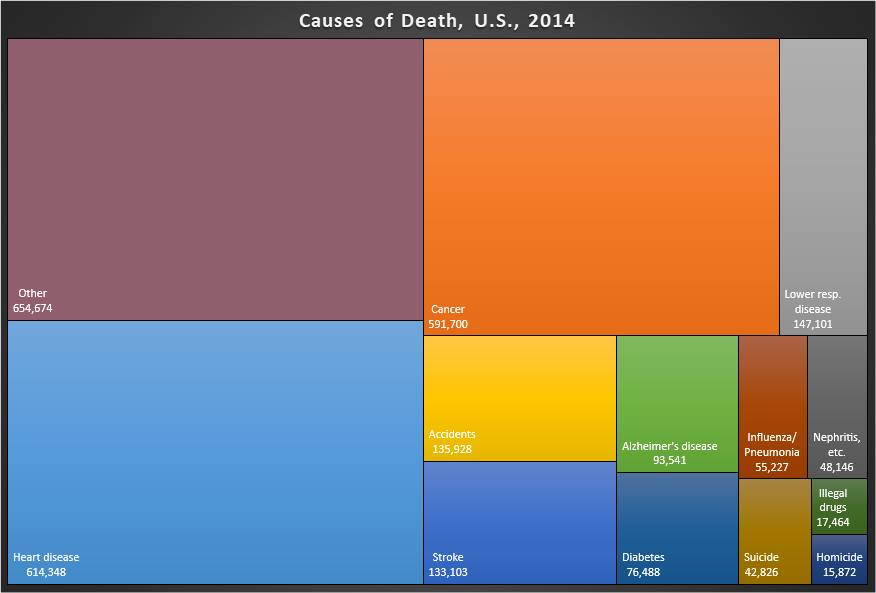
  • Graph of causes of death in humans by Mike Huemer

    Graph of causes of death in humans by Mike Huemer

    Text by Mike Huemer:

    What’s killing us? I made the following graph. I include the top ten causes of death in the U.S., plus homicide and illegal drug overdoses, because the latter two are actually discussed in political discourse.

    Observations:

    1. The top causes of death almost never appear in political discourse or discussions of social problems. They’re almost all diseases, and there is almost no debate about what should be done about them. This is despite that they are killing vastly more people than even the most destructive of the social problems that we do talk about. (Illegal drugs account for 0.7% of the death rate; murder, about 0.6%.)

    2. This is not because there is nothing to be done about the leading causes of death. Changes in diet, exercise, and other lifestyle changes can make very large differences to your risk of heart disease, cancer, and other major diseases, and this is well-known.

    3. It’s also not because it’s uncontroversial what we should do about them, or because everybody already knows. The government could, for example, try to discourage tobacco smoking, alcohol use, and overeating, and encourage exercise. There are many ways this could be attempted. Perhaps the government could spend more money on trying to cure the leading diseases. There obviously are policies that could attempt to address these problems, and it would certainly not be uncontroversial which ones, if any, should be adopted. Those who support social engineering by the government might be expected to be campaigning for the government to address the things that are killing most of us.

    4. Most of these leading killers are themselves mainly caused by old age. If “Old Age” were a category, it would be causing by far the majority of deaths. Again, it’s not the case that nothing could be done about this. We could be doing much more medical research on aging.

    5. It’s also not that we just don’t care about diseases. *Some* diseases are treated as political issues, such that there are activists campaigning for more attention and more money to cure them. There are AIDS activists, but there aren’t any nephritis activists. There are breast cancer walks, but there aren’t any colon cancer walks.

    6. Hypothesis: We don’t much care about the good of society. Refinement: Love of the social good is not the main motivation for (i) political action, and (ii) political discourse. We don’t talk about what’s good for society because we want to help our fellow humans. We talk about society because we want to align ourselves with a chosen group, to signal that alignment to others, and to tell a story about who we are. There are AIDS activists because there are people who want to express sympathy for gays, to align themselves against conservatives, and thereby to express “who they are”. There are no nephritis activists, because there’s no salient group you align yourself with (kidney disease sufferers?) by advocating for nephritis research, there’s no group you thereby align yourself *against*, and you don’t tell any story about what kind of person you are.

    In conclusion, this sucks. Because we actually have real problems that require attention. If we won’t pay attention to a problem just because it kills a million people, but we need it also to invoke some ideological feeling of righteousness, then the biggest problems will continue to kill us. And by the way, the smaller problems that we actually pay attention to probably won’t be solved either, because all our ‘solutions’ will be designed to flatter us and express our ideologies, rather than to actually solve the problems.

    — Mike Huemer